

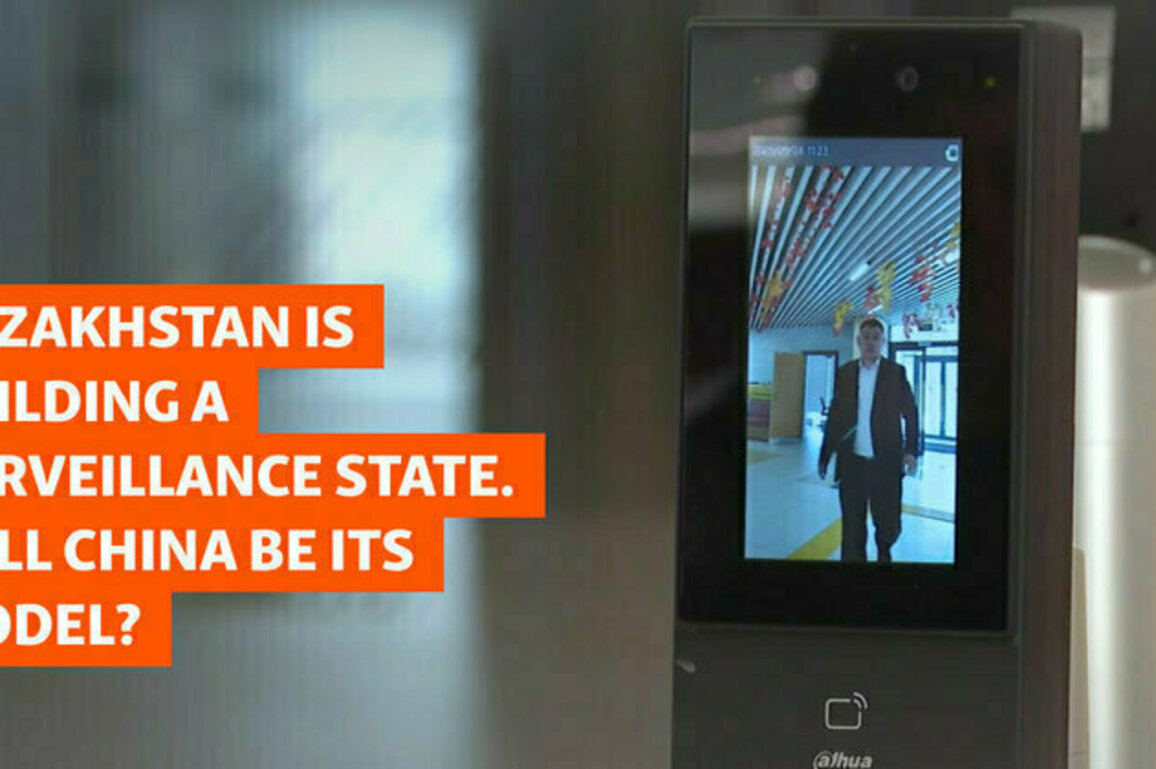
ASTANA -- As Kazakhstan forges ahead with an ambitious plan to build up a state-of-the-art surveillance network and modernize its digital infrastructure, activist Sanzhar Boqaev learned firsthand about what such a system could mean for people like him.
After arriving at Almaty airport in June, Boqaev -- a former Kazakh official turned prominent political blogger --was stoppedby police when he was identified through a homegrown AI-powered facial recognition system calledTargetEYEand listed in its database as a "civil activist."
Boqaev recorded part of the interaction on his phone and says an officer even showed him his profile in the database, which included a biometric comparison and his personal data, before he was asked to go to a police station.
A screengrab of a video taken by Sanzhar Boqaev at Almaty airport of his profile displayed on the TargetEYE program
He was eventually let go after being briefly detained at the airport and Boqaev later released footage online, saying the government was using advanced technology to track activists.
The Kazakh Interior Ministry said that Boqaev was added to the database incorrectly due to his resemblance to another individual. Interior Minister Yerzhan Sadenovsaid afterwardthat the government is not compiling a database of activists and that "technology can make mistakes, too."
"You can see it in the video. It shows my photo, name, father's name, and I'm marked as a 'civil activist.' Who else could it be?" Boqaev told RFE/RL. "Moreover, it says the database was entered by the Interior Ministry's anti-extremism department. Even the officer's last name who entered it is recorded. Yet they deny this is me [in the database]."
For Boqaev and other activists in the country, the incident offers a glimpse of a worst-case scenario where the government's digitalization push -- which includes tens of thousands of surveillance cameras deployed with facial-recognition software, a central digital ID system, and a major long-term investment in AI -- could be abused as the government looks to avert any replay of the January 2022 mass protests and bloody unrest that threatened Kazakh President Qasym-Zhomart Toqaev's hold on power.
Adding to those concerns is where much of the hardware and technological foundation for Kazakhstan's digitalization strategy is coming from: China.
Chinese-made data servers, telecoms equipment, microchips, and surveillance cameras havebecome the bedrockof Kazakhstan'sdigital-first ambitions, which continued topick up steamin September when Toqaev announced the creation of a new AI ministry.
SEE ALSO:
Kazakhstan's Atomic Maneuvers: Astana Tilts Toward Beijing In Its Nuclear Energy Ambitions
The worry, experts told RFE/RL, is not only that the Central Asian country could be left reliant on Chinese companies for its technological advancement, but that it could also adopt the public surveillance andcensorship model inside China, where civil liberty and privacy needs have been eroded in favor of state control and security.
"China, both politically and socially, is not a model for how technology should be used in a democracy," Dana Malikova, a digital rights expert who has worked for multiple civil liberties groups in Kazakhstan, told RFE/RL. "China has advanced technology, but the issue at hand is how it will be used [in Kazakhstan]."
Troops are seen at the main square in Almaty where hundreds of people were protesting against the government in January 2022.
A Homegrown Surveillance System
Toqaev has placed a huge bet on digitalization to pave the way for new economic possibilities for his country,announcingduring his September 8 State of the Nation speech that he wants "to turn Kazakhstan into a fully digital nation within three years."
A key part of the strategy is building up Kazakhstan's own local companies, which Toqaev has stated will help turn the country into a regional tech player. Kazakh firms have already developed a series of homegrown products that are being used across the country, including Target AI, which was founded in 2019 and developed the TargetEYE program that identified Boqaev this summer.
SEE ALSO:
China Continues Its Steady Expansion Into Central Asia On The Sidelines Of Big Summits
Many of Kazakhstan's most successfuldomestic tech companiesoperate at the intersection of facial recognition, AI-assistance, and biometric identification, which are fueled by the growing amount of data harvested through the tens of thousands of surveillance cameras hanging at street intersections and off buildings across the country.
Some of these cameras are installed by private businesses and individuals, but the vast majority are part of state-run programsintegratedwith AI-powered facial-recognition technology like TargetEYE.
Target AI told RFE/RL that it only provides the technology and that it is up to law enforcement agencies to decide how its products are used.
"In most cases, our company has no information about what purposes or how the platform's technical functions are applied," the company told RFE/RL in a statement.
It also told RFE/RL that its platform has already been integrated into police and supervisory systems in eight regions of Kazakhstan. That reach has helped turn Target EYE into a homegrown key tool in predictive policing and rapid-response operations.
SEE ALSO:
Leaked Files Reveal Serbia's Secret Expansion Of Chinese-Made Surveillance
But the scale of deployment and the opaque way authorities use the technology have raised urgent questions about accountability, especially after the incident with Boqaev.
The government's growing surveillance capabilities also extend beyond Target AI.
The Smart Aqkol, Kazakhstan'sdomestic version of the smart city concepttested in a small town north of Astana, came about as part of a deal between Kazakhtelecom, Kazakhstan's national telecommunications company, the Eurasian Resources Group -- a state-backed mining company -- and Tengri Lab, a Kazakh tech startup.
The model's relevance has faded from government statements in recent years in favor of other domestic surveillance products, but it highlights Astana's eagerness to build up its own national entities.
Another homegrown project iscalled Sergek, which began as the AI-driven data collection system for the security component of Astana's smart city and has since seen its usage grow.
The government has said its aim with these projects is to enhance public safety and fight crime with smart city systems that link cameras and facial-recognition software with police terminals and command centers to provide widespread monitoring.
SEE ALSO:
Leaked Files Show China And Russia Sharing Tactics On Internet Control, Censorship
But there are also concerns over how the government will be using all the data that it is collecting.
"The risk here is much higher because of the use of facial recognition," said Malikova. "That biometric data can be used both against citizens and also against the country's national security [in the wrong hands]."
The exact number of cameras deployed across the country through government programs is not known, but the Almaty mayor's office has said the city alone has at least 128,000 cameras, which Dmitry Panchenko, the commercial director of TargetAI,saidare linked to its system.
Another 6,000 camerasare connectedto the system in Atyrau, and the Pavlodar region already has at least 5,000 cameras linked to the system and isplanning to install4,200 new cameras over the next three years, according to local officials.
SEE ALSO:
Chinese-Made Surveillance Cameras Are Spreading Across Eastern Europe, Despite Security Concerns
The Defense Ministry told RFE/RL that 14,000 cameras are installed in state buildings under its control and that video data is stored on servers within military units, where they say there have been no security breaches.
The Interior Ministry did not respond to RFE/RL's questions about the number of cameras it has connected across the country and how the data is stored and used. A spokesperson only said that video data "is protected by modern means" and there have been no security incidents to date.
"All cameras installed in internal affairs bodies undergo security audits. Installed cameras are not connected to the Internet but operate in a closed contour," the spokesperson said.
Chinese leader Xi Jinping is welcomed by Kazakh President Qasym-Zhomart Toqaev at Astana Airport in June.
Is Kazakhstan Looking To Follow China's Model?
So far, Kazakhstan's expanding surveillance system has been touted for its efficiency and safety gains as it has led to some drops in local crime rates and more efficient traffic management in major cities.
But Toqaev has also spoken about the expansion of surveillance as a law and order issue, especially in the wake of the January 2022 unrest that killed at least 238 people, the vast majority of them civilians, and required a detachment of mostly Russian troops from the Collective Security Treaty Organization (CSTO) to help restore order.
"By the way, the cameras we installed in many large cities are playing a very positive role,"he saidin a February 2022 address to the nation after the protests and unrest had subsided.
SEE ALSO:
China's Hikvision, Dahua Security Cameras Heighten Risks Of Russian Attacks On Ukraine
"We need not only to restore public order but also to increase the number of cameras. The issue is not full surveillance or monitoring of our citizens' actions; this is a security matter," he added.
While Toqaev has not explicitly said he wants Kazakhstan to follow China's approach to surveillance, he has praised leading Chinese brands that have become market leaders in the field, such as during a 2019 visit to China when he visited Hikvision, the world's top manufacturer of surveillance cameras.
Both Hikvision and Dahua, anothertop Chinese surveillance camera firm, are used widely across Kazakhstan, but the two partially state-owned companies werealso sanctionedby the United States in 2020 for helping Beijing's crackdown against Uyghurs and other Muslim minorities in Xinjiang.
Both companieshave been used --and even promoted-- for their ability to track people labeled as "suspicious" and to target faces based on ethnicity.
SEE ALSO:
'The Network Wars Have Begun': China's Digital Silk Road Ignites Hi-Tech Competition
While Chinese companieshave found a large marketin Kazakhstan, the full extent of cooperation between the Kazakh government and Beijing is not known. Intergovernmental agreements between Astana and Chinese companies are published online, but they do not contain specifics in relation to contracts concluded with Chinese IT companies and there are no details in the public domain on the conditions, obligations, and terms of contracts.
But a leak of more than 100,000 documents from the private Chinese company Geedge Networks in September points to the Kazakh government turning to China to buy more elaborate censorship and surveillance systems.
Accordingto InterSecLab, a global digital forensics research institution that reviewed the leak, Kazakhstan appears to be Geedge Networks' first international client for a censorship system modeled after China's Great Firewall, which allows users to monitor online information, block certain websites and VPN tools, and spy on specific individuals.
SEE ALSO:
Uyghur Camp Survivor Details Forced Sterilization, Torture In Xinjiang
InterSecLab's report on the files also notes that Kazakhstanpreviously reliedon Russia's System for Operational Investigative Measures (SORM) technology for network surveillance hardware and software in its telecoms networks.
But documents, the report states, are "critical evidence that Kazakhstan's Internet surveillance apparatus is sourced from China, via Geedge, rather than from Russia, as previous research presumed."
The Committee for National Security (KNB), Kazakhstan's main intelligence agency, referred RFE/RL's questions to the Ministry of Artificial Intelligence and Digital Development, which said that the information in the documents "does not correspond to reality."
A Chinese-made surveillance camera installed outside the House of Ministries of Astana, Kazakhstan. (file photo)
What Will Kazakhstan's Digital Future Look Like?
While China's cost-effective and advanced hardware plays a large role in Kazakhstan, other foreign firms are moving in.
Products from Sweden's Axis Communications and South Korea's Hanwha Vision are also in use across the country and Astana recently announced a deal with Presight AI, a UAE state-backed startup that won a major contract to replace Sergek's traffic-monitoring system in the Kazakh capital. The deal calls for installing 22,000 new cameras in the city to then connect to the Emirati program.
SEE ALSO:
Reviving Uyghur Culture In Kazakhstan, One 'Reel' At A Time
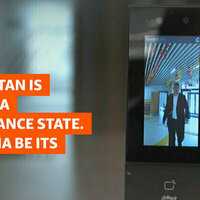
Many new residential buildings in Kazakhstan's main cities have installed Face ID devices at their entrances, which allow residents to discard using a key in place of a biometric imprint of their face.
The Kazakh government alsoannounced plansin October 2024 to launch a centralized national system for remote biometric authentication that will be implemented across all major industries. Then, in August, Kazakhstanmandatedthat banks and microfinance organizations conduct biometric authentication for issuing online loans.
Oyuna Baldakova, an associate researcher at King's College London'sDIGISILK project, told RFE/RL that this growingcentralization of detailed datain the country raises several security vulnerabilities. A centralized database is not only exposed to potential hacks but could also be leaked,as happened in June.
It could also be sold to companies or other governments, or used to monitor individual citizens.
"Over time, you will have a level of data where the state can get involved and track people," Baldakova told RFE/RL. "This can be a major problem in a system without good checks and balances."
SEE ALSO:
Rights Watchdog Says Failure To Investigate January Protest Abuses Leaves 'Damaging Legacy' For Kazakhstan
She adds that there is stilla digital gapinside Kazakhstan between its urban centers and large portions of the country with weak connections or no Internet access at all.
The Kazakh government has also said it is currentlystill short on recruitingengineersto build upits digital systems and is trying to attract more foreign investment into AI. Baldakova says there is still "not enough capacity" to realize the fully digital state outlined by Toqaev.
"At the same time, the state still has the capacity to single out certain people of interest," she said. "They can still track them and follow them through these digital systems, the Internet, and telecom networks."
RFE/RL Kazakh Service's Zholdas Orisbayev reported from Astana. China Global Affairs Correspondent Reid Standish reported from Prague.